
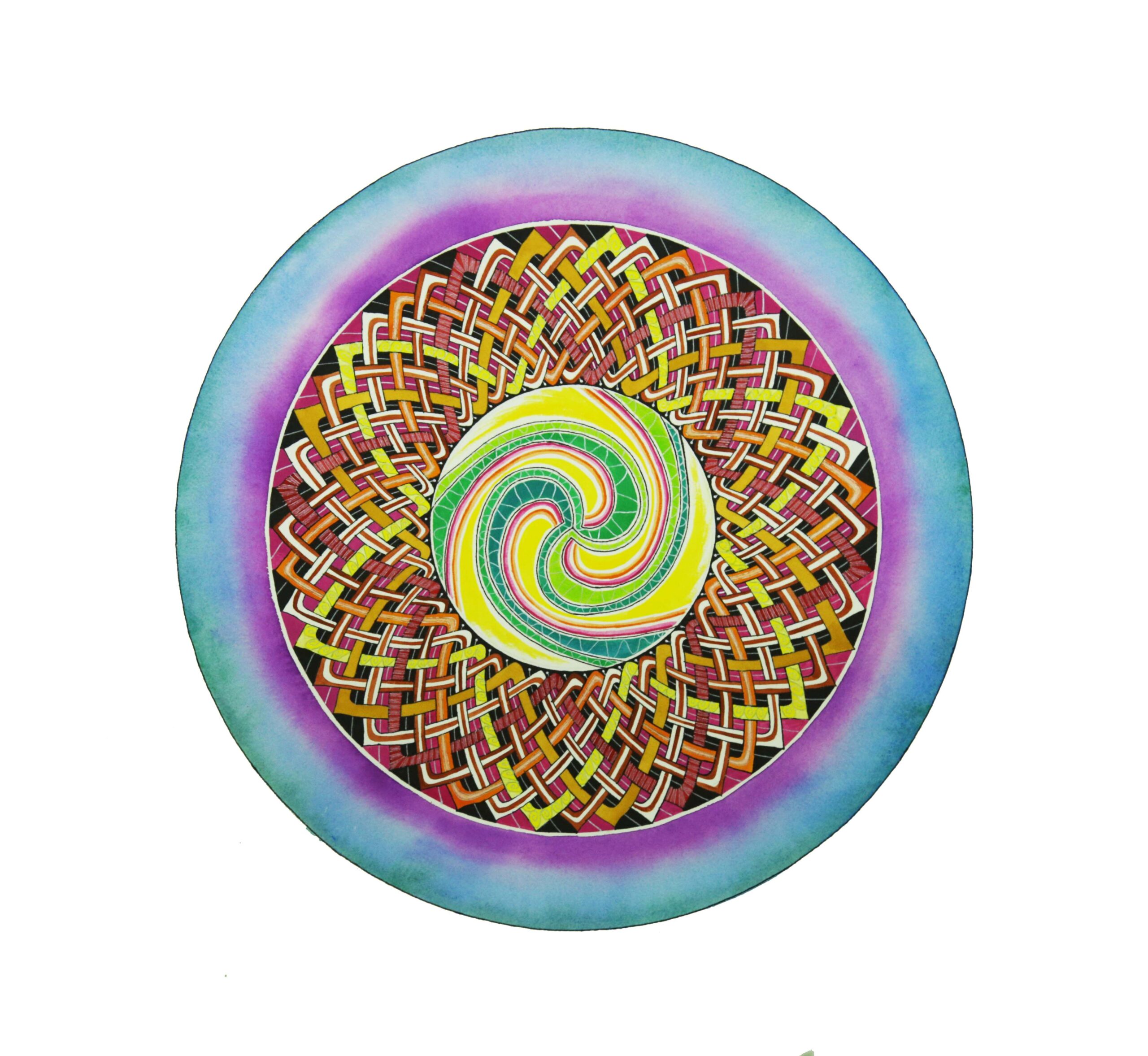
This is not my favorite painting. Not even close to my favorite. In fact, I would say that I don’t like it. I dislike the colors, especially the center part, which looks like the colors used in the Candy Land board game I played as a child.
Yet, I’ve learned so much by reflecting on this painting and what it represents about myself. I’ve often used it to illustrate my teaching, wrote two chapters about it in my book, New in the Middle, and here I am writing about it again…even though I dislike my self-portrait so much.
Here we can picture a psychologist nodding her head sagely and saying, “Hmmmmm…interesting.”
I’m writing about it because God prompted me that it was time to paint a new self portrait, but I have to tell you about this old one (painted when I was 39!) before I can start exploring what the 47.0 version (painted 2 years ago) represents. Of course, my hope is that you will learn something new about yourself, and if you are brave, even try to create your own image that can reveal part of the amazing truth of who God created you to be.
Hmmmm….interesting! Forward march!
Maybe some of you have heard me explain this self-portrait and how this abstract image represents the trinitarian aspect of human beings. Each of us are made of three parts: body, soul, and spirit. In my image, the body is the outside layer, the soul is the middle layer, and the spirit is the inmost part.
So my self-portrait, conveniently, represents you too! Take a look at yourself!
In our experience, it is not so simple: the body is on the outside, but also on the inside. The soul (a non-material part) can be described as a combination of our mind, personality, and emotions. While the spirit is another non-material part that is the place where we commune and connect with God. God created all of this, and it is good! We are made in His image.
When I paint a picture, I never know what it will turn out looking like. I don’t have an end goal, which makes painting non-stressful and restorative. Often when you try to make a piece of art turn out a certain way, you end up disappointed with yourself and your skill level. I love the adventure of seeing what happens. However it turns out, it turns out. If I don’t like it, I take what I’ve learned and try something different next time. By not having a specific end goal and refusing to throw away every piece of art I dislike, I feel like I’ve found a way for my subconscious to come forward and speak for itself.
Let me interpret what I’ve learned about myself through this image.
In short: I didn’t even bother trying to make the outside layer, which repsresents my body, beautiful. It is functional. I carry it around, like a piece of awkward luggage. My soul/mind (middle layer) is very busy, maybe we could say over-busy thinking and over thinking. My spirit…well, the idea is okay, but it needs work. I think it could be better. The three layers of me don’t seem to go together well or match. Maybe a psychologist would say that I’m not integrated. Maybe a spiritual person would say I’m not whole. A trauma-oriented person might say I’m experiencing dissociation because my identity was fractured by trauma. My inner self and physical self seemed to have completely disconnected from each other. Hmmmm…..Interesting.
I have often said that I’m disconnected from my body or that my body doesn’t seem to represent who I am.[i] Most people never notice their bodies or how well they are functioning until they have a problem; a stubbed toe, a twisted ankle, or a broken bone serves as a wake up call that our body exists and sometimes doesn’t work right. This does not necessarily mean a person becomes disconnected from their body. Once things heal up, they usually go back to not noticing their body. They just feel like their body. They are their body.
I guess the first 14 years of my life were like this, but from the point of my spinal cord injury onward, I felt very separate from my body. When I looked down at my paralyzed legs, I felt like they did not belong to me. They looked like a plastic maniquin. In therapy I learned to move my legs around using my hands or some looped dressing sticks. My upper body still felt like me, but I had been cut in half. Though I learned to walk again, I never regained a sense of my lower body being myself. Though technically my legs carry me around, I have been burdened by care of them and the pain they have caused me over the years.
Maybe some of you have felt this. When something drastic hits us physically, our relationships with our bodies change, and our minds start working in ways they didn’t before. Suddenly we feel like different people. We don’t feel whole or like ourselves.
In my self-portrait, the whole middle section of this picture represents my mind, and there are many strong threads, each quite different from the other, each contributing to the whole. My mind is quite busy! I’m coming to understand that the busy status could be due to the big fracture within my personality that resulted from extreme circumstances in my youth. There are parts of me that don’t seem to relate to each other very well. Like there are two (or more) different Sarah’s at war within battling for control. It seems like half my mental power goes into the act of survival, keeping my body healthy and moving. This protective part of me is on high alert when pain ramps up and yells: “Red alert! Get away! Get safe! Take some medicines to control the pain!” This part, which I call “Survival Sarah” can be a controlling because I know when I’ll run out of energy (usually much earlier than everyone else), and I try to get home and settled before the princess turns back into a pumpkin. Survival Sarah feels like everything depends on her. She is all alone and weary from so much hard work…for so many years.
Then there is a whole other identified thread or part of Sarah. Let’s call her “Thriving Sarah.” She loves learning, she loves living, she is creative and love to teach about what God is teaching her. This is the Sarah who has homeschooled her kids, taught on campus, mentored leaders, painted pictures, etc. This Sarah even forgets that she is in a disabled body. When my mind is lively, when I’m writing or reading, I stand up and feel a bit surprised at my stiff and painful legs. I was so disconnected from them while residing in my busy brain. Standing up often switches me back over into Survival Sarah.
Yet, I have to be thankful for Survial Sarah. If it wasn’t for her warning me of impending danger, keeping me on track with rehab, or helping me step out of triggering situations, I wouldn’t be here functioning so well today. I’m also very thankful for Thriving Sarah who helps me realize there is much more to life than mere survival.[ii]
I really like the Thriving/Thinking Sarah. See how much bright detail I put into that middle layer of the image. My mind is hot with action! This is the Sarah that seems to feel God’s presense. I wonder though — feeling is a physical sensation, and I’ve been cut off from my body so long, that I regularly fall back into my mind and the joy of thinking all my happy thoughts about God. Maybe I’m missing out.
What situations cause you to not feel like yourself? On the other side, what activities make you feel like, “This is the real me!” In my next post, I’ll show you my updated self-portrait and talk about how God is moving me toward wholeness and helping me accept and experience my body as myself. Let me tell you…it feels good.
For any of us, self-examination and movements toward whole-hearted and whole-bodied appreciation of God’s healing work will result in better ability to participate in the life He has granted each of us…each day…each step.
[i] This status of not feeling connected to your body is called depersonalization. Though I painted this image about 8 years ago, I’m still learning new things about my dis-integrated state. The books listed in the recommended reading have informed my understanding and my movements toward wholeness.
[ii] Here I’m introducing the idea multiplicity. Each of us are so complex! God made us that way and it is not bad! Our whole personality is made of many subparts or aspects. Some of us have angry parts, some of us have parts that want to give up. Most of our parts try to protect the hurting younger core parts who are often exiled due to pain. Serious trauma leads to internal fragmentation, but even people who have not faced trauma and/or abuse can identify different parts of their personality that emerge in different circumstances or when stressed. Just as we need to pay attention to what our pain is telling us, we also can start to look at these personality protectors and see what exactly they are protecting. The end goal is to find and live from our True Self, the essence of you and me that lives in relationship with God.
*Recommended Reading:
Boundaries for Your Soul: How to Turn Your Overwhelming Thoughts and Feelings into Your Greatest Allies by Allison Cook and Kimberly Miller
Altogether You: Experiencing Personal and Spiritual Transformation with Internal Family Systems Therapy by Jenna Riemersma. This book approaches the IFS model in a different way often using different language. Jenna’s website has many free videos and audio meditations for you to use as you understand your parts more: https://jennariemersma.com/
No Bad Parts: Healing Trauma & Restoring Wholeness with the Internal Family Systems Model by Richard C. Schwartz.
*When I recommend reading, I put forward books that have helped me gain new understanding. This doesn’t mean I wholeheartedly agree with (or understand!) everything written. The ideas supporting Internal Family Systems are growing in popularity and are used by many people, Christan and other. Please note that I do not agree with every way it is used. I will explain more in upcoming posts.
0 Comments