

As I meditate on the broken pottery theme, let’s consider the fragments. Normally, broken pieces are thrown away, worthy only of the garbage. We threw away a broken mirror recently. The big, sharp shards were dangerous, so we took care to place every piece in a tough, old rice bag that wouldn’t split open.
We don’t want to do this with human lives. We serve a God, our Good Shepherd, who looks on us in our broken and helpless states and refuses to abandon us or toss us (and our complicated lives) into the garbage can. Amazingly, we can offer our brokenness to God, as an acceptable sacrifice.
My sacrifice, O God, is a broken spirit; a broken and contrite heart you, God, will not despise.
Ps. 51:17
If God accepts our brokenness, maybe we also need to accept it. Often, we don’t know how to do this. According to the kintsugi way of thinking (see this post), Makoto Fujimura encouraged us to “behold the brokenness.” Beholding connotates gazing lovingly at each individual shard with kindness, looking at the curves and sharp edges as shapes in themselves. When we behold in this way, we have “artist eyes” that find beauty where others may only see garbage that needs tossed. When brokenness is beheld by God, it is shame that gets tossed aside.
When we think of trauma (such as abuse or neglect) or accidents (such as the ones I’ve been in), it is easy to see the physical brokenness. The once healthy body doesn’t function as God intended anymore. The lasting impact of the fragmenting of our psyche often goes unnoticed until long after the accident, abuse, or extreme situation. Researchers such as Gabor Mate and Bessel van der Kolk have brought forward the new understanding of the long-term effects of trauma. It is not just in our heads. Our bodies literally keep the score. The trauma exists as body memories, but also as extreme protective and coping responses that can dominate our lives and mask our true self.
Let’s join Richard Schwartz and his Internal Family Systems (IFS) model and call these protective and coping responses “parts.” With the inspiration from Fujimura, let’s “behold” these parts or pieces. The best way to normalize these parts is to understand that everyone has them, but they get extremely loud or strong in people who have been through very hard life situations.
Have you ever felt an internal conflict? For me, this can happen at night and leave me tossing and turning. For example, my brain (or yours!) might think, “Part of me feels like so angry I want to scream, but another part of me feels like I just need to trust God in this.” Or we might hear strong voices in our heads saying highly critical things to ourselves: “Why in the world did you do that??….Again!” Some voices suggest ways for us to get a relief: “Things have been so hard lately, I deserve a large ice cream (or whatever floats your boat!)” To add further drama, other parts get angry at ourselves for being angry at ourselves! Yes, the inside of us is complicated. To some extent, we have all felt this way because we are human, and for most of us, internal conflict can generally be resolved and harmony restored.
After trauma, those parts can develop a whole life of their own. Our protective responses grow to superhero strength in their attempts to make sure we won’t get hurt again. Imagine a typical scenario: “I’m never going to trust a man again.” Done deal. Using IFS language, we would call this untrusting part a “manager.” Its job is to make sure the troubled woman never gets hurt. It works to avoid events or relationships that might trigger pain. Other parts may develop in response. Now that the untrusting woman will never enter a relationship, a lonely “exile” surfaces bringing up painful emotions: “No one has ever loved me.” Then a “firefighter” comes to the rescue and tries to extinguish the pain. She heads to the fridge and pushes her pain down with that ice cream or numbs out on her phone. Another “helpful” manager chimes in with some heavy criticism and self-condemnation in hopes of stopping the unhealthy food or media intake. And it goes on and on.
In this simple story, we have seen four fragments or parts. An untrusting manager, a lonely exile, an ice-cream-eating/scrolling firefighter, and a critical manager. The woman tells herself: “I’m not a trusting person.” What she doesn’t realize is that only part of herself is not able to trust.
Stick with me. I know these may be new ideas, and I’ve listed a few really good resources at the bottom if these ideas resonate with you. The words manager, firefighter, and exile are basically ways to categorize and work with our normal human reactions. Take a look at this diagram taken from Boundaries for your Soul by Allison Cook and Kimberly Miller.
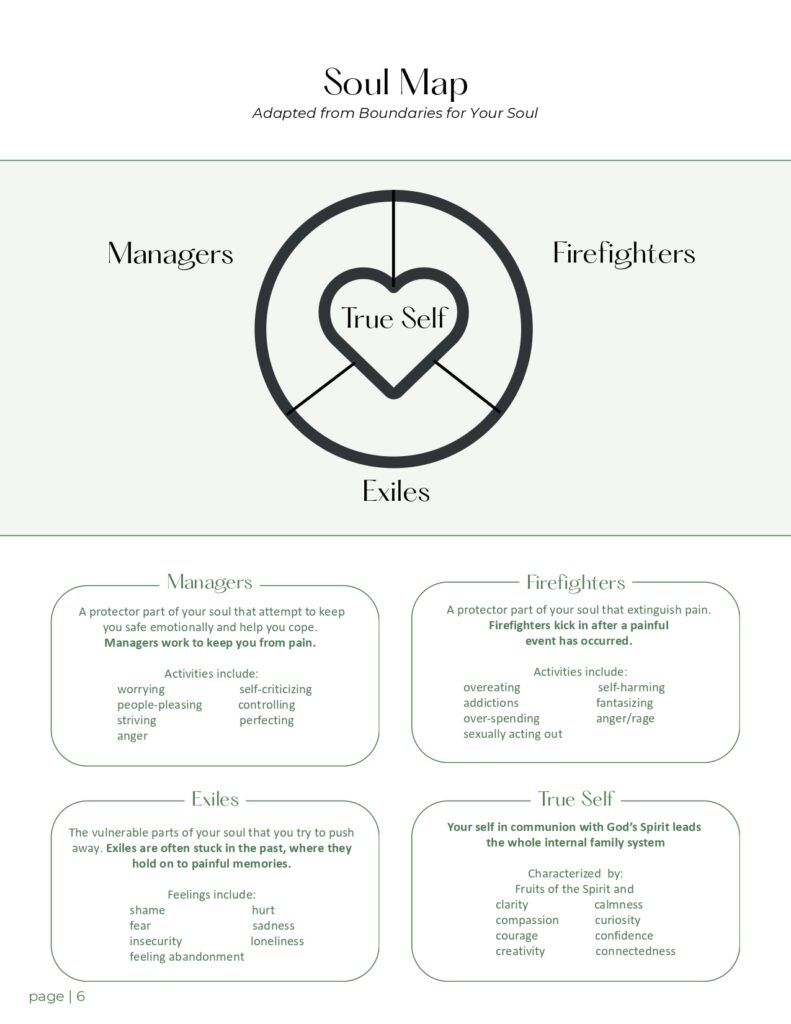
Over the last few years, I’ve learned to look with compassion at these parts and understand the roles they are trying to play. The goal of doing “parts work” is to create a healthy relationship between the parts so that you and I don’t feel as conflicted and can live our lives a place of True Self. Schwartz challenges us to not see our parts as bad in themselves. Yes, the roles they often take on are not good, but if these parts become unburdened, they take on the positive roles they were originally designed for.[i] As a person with various medical situations that require me to live my life differently, I have some strong managers on board. They have really dominated my life. I’ve introduced Survival Sarah in previous posts, but next time I’ll tell about my first memory after my spinal cord injury when I think she sprang to life.
About a year ago, in meetings with my spiritual director (before I had read any of the books mentioned below), I found myself telling my director that I feel like I’m two different people. There is “Survival Sarah” that works super hard just to keep this body running and prevent pain, and there is “Thriving Sarah” that likes to read, study, write, teach, paint, etc. When I’m in survival mode, I feel like a different person who is not able to think and barely able to communicate. Survival Sarah takes over when I’m in pain. All she can think of is “Find a place to sit down! Find a way to get off these legs! Get out of pain—fast.” It is hard to converse with neighbors on an evening walk when your brain is doing that. As a result, I feel like a social dud whenever standing up and talking is required. I feel like telling people, “This is not who I really am.”
When I am ruled by Survival Sarah, I’m dominated by subconscious urges to flee from pain and be safe. But when I take time to “behold” this dominant manager part of me, I can really appreciate it for taking care of me all these years. I can even separate from these strong survival urges—this stuck part of me is not who I really am.
Here’s the amazing thing: now that I’m appreciating this Survival Sarah, she is learning to quiet down and is not like a screaming bully inside my head. I trust her to keep me on track, but she isn’t controlling my reactions now. She is helping me be proactive in a healthy (not obsessive!) way.
And this is just the beginning of my own parts work. I’ll be writing more about IFS because, as my friend who is a trauma therapist told me in a text, “…with multiple trauma events it can be hard to move forward without parts work.” She went on to say, “I wouldn’t be surprised if you had some changes in pain levels as you understand parts more.” And this is amazingly true! My overall muscular and emotional tension is coming down. Our parts manifest in our body and use it (in troubling and painful ways) to carry out their defensive work.
Have you seen the movies Inside Out and Inside Out 2? They demonstrate these ideas brilliantly and also reveal the goal of IFS, which is to build a healthy working relationship between these parts.[ii]
In my next post, I’ll share more of my own parts story. After that, I’ll talk about our part that is not a part: Our True Self, or Spirit-led Self as some authors refer to it. The Bible calls it imago Dei! We are created in God’s image with a special place inside us (our spirit), perfectly designed to connect to his Spirit. Yes!
[i] Richard C. Schwartz, No Bad Parts: Healing Trauma & Restoring Wholeness with the Internal Family Systems Model (Sounds True, 2021), 21.
[ii] Ibid.
Please note this: Internal Family Systems is a way of viewing our intneral world, a way to make sense of the voices in our heads. I teach and use IFS as a way to develop healthy and gentle self-awareness. That’s it. You may read things about IFS online that don’t line up with how we view ourselves biblically. People of all religions can interpret IFS in many different ways. I’m only using it as a way to know ourselves and understand our reactions. Then, knowing ourselves, we can know God better.
I’d start with these books if you want to learn more about Internal Family Systems:
Boundaries for Your Soul by Allison Cook and Kimberly Miller
Altogether You by Jenna Riemersma
No Bad Parts by Richard Schwartz



It is really interesting and encouraging. Here is few takeaway from this reading is the idea that brokenness is not something shameful or disposable. I found the comparison between broken pottery and human lives very meaningful because it reminds us that even when we feel damaged or wounded, we still have value and should not be rejected. Instead of hiding our brokenness, we can acknowledge it and accept it as part of who we are.
I also appreciated the discussion about inner conflicts and how our reactions are often connected to painful experiences or trauma. The idea that different “parts” of us may respond in protective ways helped me better understand why people struggle internally. Sometimes our reactions are not weaknesses but attempts to protect us from being hurt again (kinda like a defense mechanism).
Also the understanding of wounded parts and healing. Healing does not mean ignoring or fighting the wounded parts of ourselves, but learning to understand them with compassion. By recognizing these parts and why they exist, we can begin to heal, grow, and move toward a healthier and more peaceful version of ourselves.
Such a great summary, Tenngoi! Really – you got the point. That makes my heart happy! Yes – it is exactly like defense mechanisms, and honestly, there are many reasons to be grateful for defense mechanisms. The problem is when they start to dominate our lives. It is funny how much easier it is to show compassion to others and then be so hard on ourselves. But yes, “understanding them with compassion” – that is the key.
Sarah, so happy to hear your pain levels are decreasing!! Praise the Lord. You give me a good reason to watch Inside Out again. Thanks for your writings, they always bring me new insights.
Wendy, so good to see you here! Thanks for your thoughts. Yes! Watch that movie – and grab some friends – it is fun to discuss. So often, we really don’t know what to do with our harder emotions. Blessings to you!
Your article came just at the rignt time for me Sarah – Thank You!
It helped me recognise what was happening around me was affecting how I was/wasn’t managing it on the inside!
Halleujah!
Paul! I’m sorry I didn’t see this sooner! I’m blessed that my article was able to help you. There is always a lot going on in the inside of us. It feels good (for me!) to have a language to describe and make sense of it all. Blessings to you!