
We often joke about consolation prizes. After all, they confirm what we, in our heart of hearts, knew all along: we are not the winner. We are second, third, fourth, or even last place in whatever contest we just participated in. We did not get the prize or recognition we wanted. The cheap consolation prize gathering dust on the shelf reminds us of that painful experience of being a capital L-oser.
Darker: when we joke about how our lives turned out and call something very negative and permanent the consolation prize. “This is what I got after all my hard work! After all my pain! This is the life I’ve ended up with.” For many years, I battled very deep disappointment regarding the status of my legs. Yes, I can walk functionally. Praise God for that. But functional ambulation is not going on a long walk with my husband through the woods, or even around the block. I can stand up and walk long enough to make dinner or go for a quick grocery shopping trip, but I can’t do the fun things.
For my whole remembered life (since I don’t remember much at all before my accident when I was 14), I’ve been working on walking. There were years when it went well. Under normal circumstances many people didn’t even notice my disabilities, but I was always aware of how much more difficult it was for me to get around compared to others. Walking has been the continued goal of my life. This determination ramped up when I started experiencing intense and disabling pain around 2017. I have pushed through surgeries and much pain to pursue this goal of walking, I have hated my legs for not being and doing what I wanted them to do, and I have lived with the deep-rooted fear of what will happen as I decline with age. How will I handle the pain without going crazy or getting addicted to pain meds?
About 3 years ago, when a loving, but firm therapist confirmed that my walking would not necessarily improve and I needed to find other ways to enjoy life, I needed to start thinking differently. Rather than continuing to be a failure in the goal of increasing my walking ability, I needed to shift gears and move toward acceptance. My old occupational therapy skills needed to come forward and help me learn to adapt to my limitations rather than be limited by them. But first, I had to be willing to adapt. That, my friends, was a pride issue! It felt like giving up not moving forward.
As a I processed my frustration with a friend, she lovingly wondered with me, “Since walking has been your goal for your whole life, what could be a new goal for your life now?” This question hit the mark and felt like God gently suggesting a mental shift in gears for Sarah. There are other worthwhile goals in life. What would mine be?
The answer: Consolation.
This is the prize.
Consolation is comfort—real comfort, not luxurious, short-term indulgence. With acceptance of my reality and finding new goals for life, I have found a deep peace for my soul. Without the anxious striving to be something I’m not physically capable of being, I’ve come to a place of rest and the wonderous green pastures of Psalm 23. I have changed (and continue to change) my relationship with my body and my pain to a relationship of nurturing acceptance. I take care of my body, and it takes care of me and represents me to others. It carries me. This ongoing journey has become my way of being. Rather than trying to go back to my old normal that I love and miss or trying to live up to unrealistic expectations for myself, I seek consolation as the prize, my new normal.
Consolation is often contrasted with desolation. In short, desolation takes place when our hearts move away from God or fall asleep to what he is doing in our lives and around us. We lose touch with who we are in Christ. In this place, we are often reactive and distressed. For me, pain triggers desolation like nothing else. Consolation, on the other hand, involves our hearts being rightly connected to God no matter what is going on. We are aware of his movements inside and around us. Obviously, it is much easier to feel consoled when things are going the way we want them to, but God offers consolation when things are not going at all as we expected. This is God’s promised “peace that passes all understanding” (Phil. 4:7).
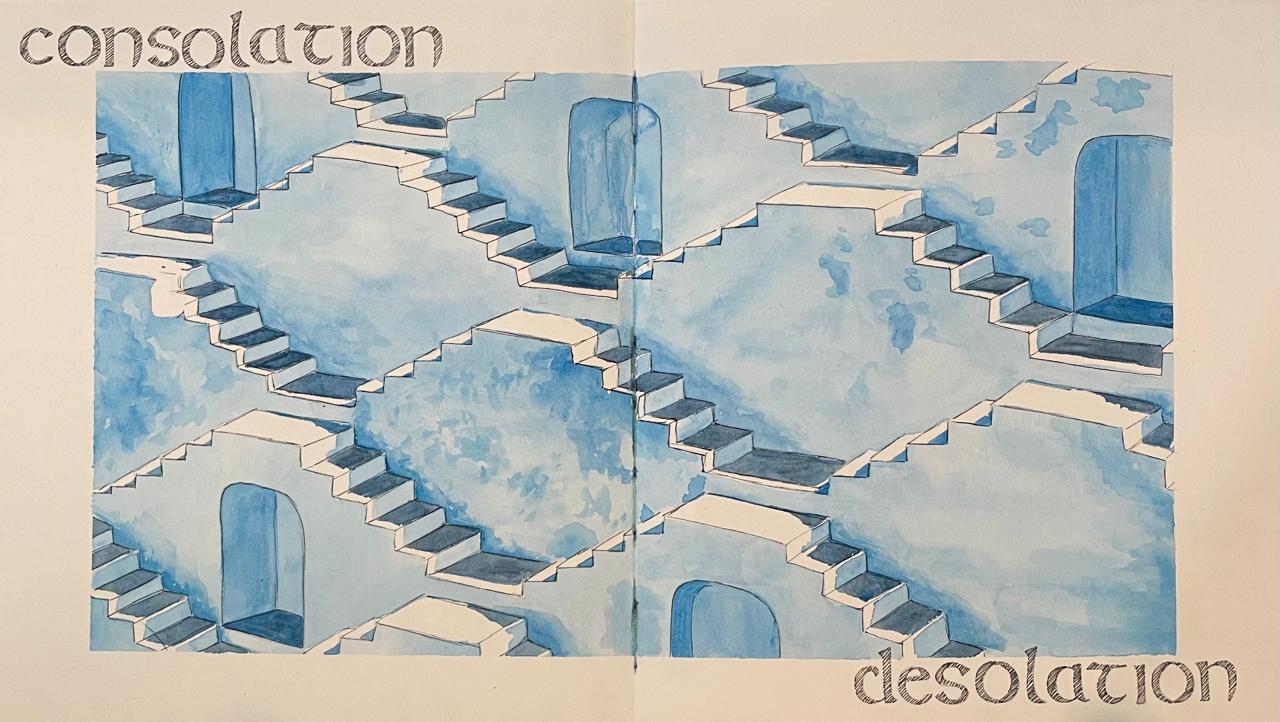
As my painted image above shows multiple ups and downs, we can understand this as normal life. Desolation is not sinful. It is a normal human response. Times of desolation often serve to increase our longing to return to God. The important difference for those of us in physical pain is to know that there really is a way back up after we have spiraled down into desolation. We aren’t helplessly stuck down in the pit forever.[i]
Maybe you are thinking, “Sarah, I’m in some definite desolation. Where do I find this consolation? How do I get this amazing prize??”
When faced with deep pain, emotional or physical, the primary help for me has been in growing my skills in staying calm. This takes practice. Fear ramps up the pain and skillfully anticipates more pain. Don’t underestimate the power of the fear/pain cycle.[ii] Some pain experts say that fear accounts for about 50% of our pain. Hmmm…interesting. This idea motived me to figure out my fear. We need God’s help for this, as well as the help of our good bodies. Though our bodies may not be all we want them to be, there is plenty of goodness inside this amazing anatomy of ours. God designed us with a special tool that I will introduce to you.
“Figuring fear out” isn’t the best way of looking at this. Figuring it out involved reading articles, thinking, listening to podcasts, and problem solving. When we are afraid, our bodies do not work the way God intended. This is a body problem not just a brain problem. Everything inside our bodies tightens up and constricts—especially the breath.
In my own experience, learning to notice my breath is the special tool that has been the top way of moving away from fear. Notice that I said “notice.” I didn’t say control. Once I started noticing, I realized that I hardly ever breathe freely. With my nasal passages often congested, and my jaw clamped, how can my breath flow? I noticed my shoulders constantly hiked and pushed forward to contract against pain, which served to restrict the lung space. The tightness of my body easily flowed upward to increase the swirling tension in my brain.
As I write, it is hard to explain how precious breathing has become to me. My life was so tight, and I was trying so hard—so hard without the assistance of freely flowing breath. The chronic fear and desolation patterns made me feel like all I could do was survive. I guess this makes sense. Our breath is what keeps us alive!
Am I saying that learning to breath is a consolation prize that I value enough to make a lifetime of disability worth living?
Well, breath work is a step toward calmness. Calmness in the face of fear and pain links us to the unfathomable, non-sensical peace of God. The peace of God—a primary attraction of this intimately personal and loving God we serve—makes life worth living. And I’m still living.
Here is a simple practice for when you feel fear of pain coming into your body.
- Notice the fear. It is fear. It is not a failure that you feel fear. It is a normal human response.
- Place your hand on your stomach or your chest. Just rest it there lightly. My favorite position is with my right hand over my heart. For me, it symbolizes self-compassion.
- Notice how your hand rises and falls with each breath. You don’t have to try to take deep breaths, just notice.
- If your mind drifts off, don’t worry about it. Just bring your attention back to your breath.
Don’t rush this, but once you have learned to notice your breath and feel settled, you can ask God for a prayer word to pray as you inhale and exhale. Mine is “Jesus.” Very simple, but so good! I started doing breath work about 4 years ago, and I wish I had started 10 years ago, as it would have been a very helpful skill to have on board through my painful surgeries and recoveries. Rather than trying to focus on breath for long periods of time, I choose to do it more often throughout the day for shorter amounts of time (like a minute or two). That said, there is no wrong way. Just breathe, my friends. Just notice how good it is! What a prize!
Comrades, when you do this, with or without the prayer word, you are practicing stillness and the presence of God in the face of fear. Without words, we acknowledge that we absolutely depend on him. I salute you!
This post is lovingly dedicated to my courageous friend Lene.
[i] To learn to practice consolation and desolation, I recommend The Ignatian Adventure: Experiencing the Spiritual Exercises of Saint Ignatius in Daily Life by Kevin O’Brien, SJ. This important practice helps to normalize the ups and downs of life. For those of us in touch with our pain and trauma, we can talk about our desolation so easily! However, regularly recognizing consolation helps to break the negative cycles we find ourselves stuck in. When we do this, we move our awareness away from our pain, even if it is just for a few seconds. This is a powerful step toward regaining wholeness.
[ii] Read The Way Out by Alan Gordon to learn more about the fear/pain cycle.
Another great resource to guide your breath work is Every Breath We Take: Living in the Presence, Love, and Generosity of God by Terry Wardle.

0 Comments